


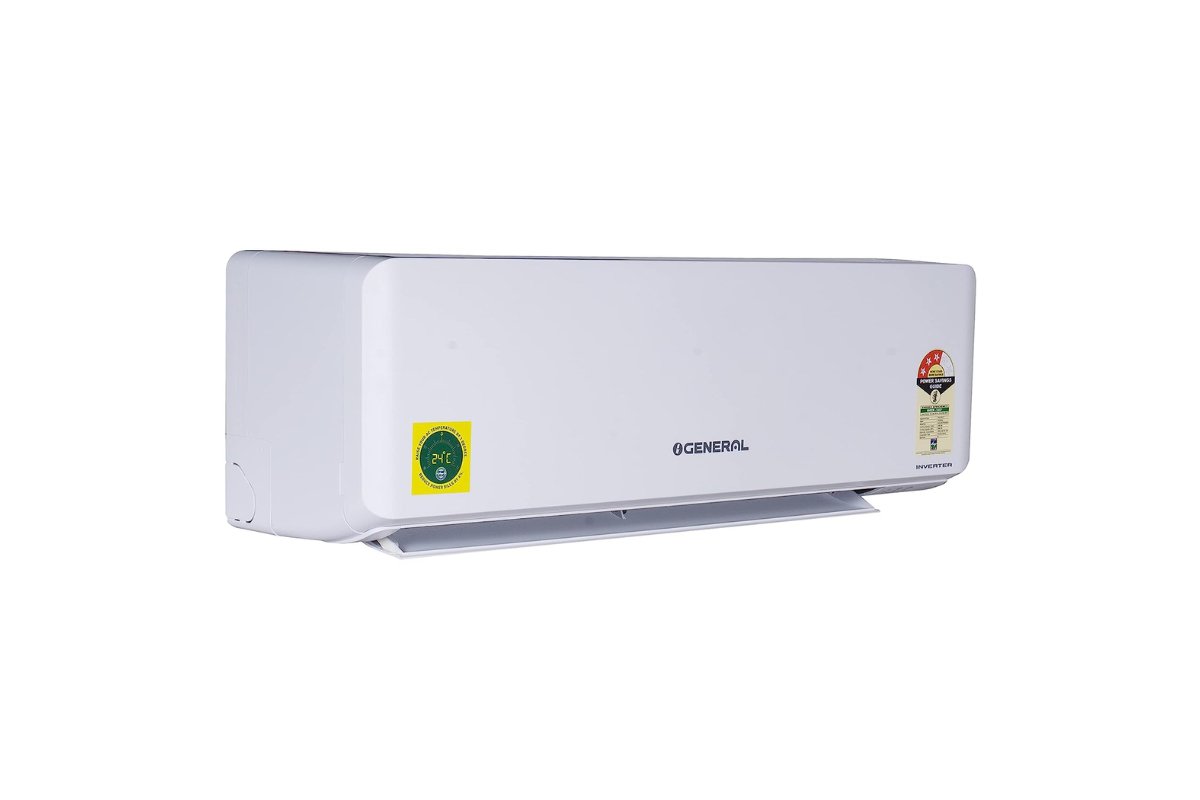

Choosing the right air conditioner capacity is one of the most important decisions when buying a new AC in the UAE. An air conditioner that is too small may struggle to cool your room, while an unnecessarily large unit can increase the initial purchase cost and may not deliver the comfort you expect.
When comparing O General AC tonnage, three popular capacity options for homes, apartments, offices, and larger rooms are 1.5 ton, 2 ton, and 2.5 ton AC systems.
But which one should you buy?
The answer depends on more than room size. Factors such as ceiling height, sunlight exposure, insulation, number of occupants, windows, floor level, and heat-producing appliances can all affect the required cooling capacity.
In this guide, we compare O General AC 1.5 ton vs 2 ton vs 2.5 ton to help you understand the differences and choose the right capacity for your property.
What Does O General AC Tonnage Mean?
Before comparing different capacities, it is important to understand what AC tonnage means.
In air conditioning, tonnage refers to the cooling capacity of an AC rather than its physical weight.
As a general HVAC conversion:
- 1 ton ≈ 12,000 BTU/hour
- 1.5 tons ≈ 18,000 BTU/hour
- 2 tons ≈ 24,000 BTU/hour
- 2.5 tons ≈ 30,000 BTU/hour
- 3 tons ≈ 36,000 BTU/hour
Therefore, when you compare a 1.5 ton, 2 ton, and 2.5 ton O General AC, you are essentially comparing different levels of cooling capacity.
The higher the tonnage, the greater the cooling capacity. However, higher capacity does not automatically mean better performance.
The goal is to select an AC that matches the actual cooling requirement of your room or property.
O General AC 1.5 Ton vs 2 Ton vs 2.5 Ton: Quick Comparison
| Feature | O General 1.5 Ton AC | O General 2 Ton AC | O General 2.5 Ton AC |
| Approx. BTU capacity | 18,000 BTU/h | 24,000 BTU/h | 30,000 BTU/h |
| Suitable for | Medium rooms | Large rooms | Larger rooms/open areas |
| Cooling capacity | Moderate | High | Higher |
| Typical application | Bedrooms, living rooms | Large living rooms, offices | Large rooms, commercial spaces |
| Energy use | Generally lower than higher capacities | Moderate to high | Higher when operating at full capacity |
| Installation | Usually straightforward | Requires suitable installation | May require more planning |
| Best for | Moderate cooling loads | Higher cooling loads | High cooling loads |
These are general comparisons. The correct capacity should be selected according to the actual cooling load of the space.
O General AC 1.5 Ton: Who Should Buy It?
An O General 1.5 ton AC provides approximately 18,000 BTU/hour of cooling capacity.
It can be a suitable option for medium-sized rooms where a 1 ton system may not provide sufficient cooling.
Where Can a 1.5 Ton O General AC Be Used?
Depending on the property’s conditions, a 1.5 ton AC may be considered for:
- Medium-sized bedrooms
- Master bedrooms
- Living rooms
- Dining areas
- Home offices
- Small commercial rooms
- Medium-sized offices
For example, a medium-sized bedroom with normal ceiling height and reasonable insulation may be suitable for a 1.5 ton system.
However, a room with large windows, strong direct sunlight, poor insulation, or a high ceiling may require more cooling capacity.
Advantages of 1.5 Ton AC
A 1.5 ton unit can offer a good balance between cooling capacity and equipment size.
It may be suitable when:
- The room has a moderate cooling load
- The space is not excessively large
- You want to avoid unnecessary oversizing
- The AC will be used regularly
- The room has reasonable insulation
If your room is significantly larger or exposed to substantial heat, moving to a 2 ton system may be more appropriate.
O General AC 2 Ton: Who Should Buy It?
An O General 2 ton AC provides approximately 24,000 BTU/hour.
It offers substantially more cooling capacity than a 1.5 ton unit and may be appropriate for larger rooms and spaces with greater heat loads.
Where Can a 2 Ton O General AC Be Used?
Depending on the cooling requirements, a 2 ton system may be considered for:
- Large bedrooms
- Large living rooms
- Open-plan living areas
- Offices
- Meeting rooms
- Shops
- Larger residential spaces
A 2 ton AC can be particularly useful where a 1.5 ton system may struggle during periods of high outdoor temperatures.
Why Choose a 2 Ton O General AC?
You may want to consider a 2 ton system if:
- The room is larger
- There are several occupants
- The room receives strong sunlight
- There are large windows
- Ceiling height is above standard
- The room contains heat-producing equipment
- The property has higher cooling requirements
However, you should not automatically upgrade to 2 tons simply because you want faster cooling.
Correct sizing remains more important than maximum capacity.
O General AC 2.5 Ton: Who Should Buy It?
An O General 2.5 ton AC provides approximately 30,000 BTU/hour of cooling capacity.
This higher capacity can be useful for larger spaces where 1.5 ton or 2 ton systems may not provide sufficient cooling.
Where Can a 2.5 Ton O General AC Be Used?
A 2.5 ton system may be considered for:
- Large living rooms
- Large open-plan areas
- Spacious offices
- Shops
- Showrooms
- Commercial rooms
- Large residential spaces
It may also be appropriate where the heat load is unusually high because of extensive glass, direct sunlight, high occupancy, or equipment.
When Is 2.5 Ton Better Than 2 Ton?
A 2.5 ton AC may be worth considering when the cooling requirement is between the typical capacity ranges of a 2 ton and 3 ton system.
For example, a large room with significant sunlight exposure may require more cooling than a standard 2 ton application.
However, professional assessment is recommended before choosing a higher capacity.
1.5 Ton vs 2 Ton: What’s the Difference?
The main difference is cooling capacity.
A 1.5 ton system provides approximately 18,000 BTU/hour, while a 2 ton system provides approximately 24,000 BTU/hour.
That means a 2 ton AC can provide around one-third more nominal cooling capacity than a 1.5 ton unit.
Choose 1.5 Ton If:
- Your room is medium-sized
- Heat gain is moderate
- There are limited occupants
- Windows are not excessively large
- Insulation is reasonable
- You want to avoid unnecessary capacity
Choose 2 Ton If:
- Your room is larger
- Heat gain is higher
- There are more occupants
- The room receives significant sunlight
- The ceiling is higher
- The space contains heat-generating equipment
The correct decision depends on the complete cooling requirement.
2 Ton vs 2.5 Ton: What’s the Difference?
A 2 ton AC provides approximately 24,000 BTU/hour, while a 2.5 ton unit provides approximately 30,000 BTU/hour.
The additional capacity can be useful for spaces with higher cooling loads.
Choose 2 Ton If:
- The room has a moderate-to-high cooling load
- The area is large but not exceptionally large
- Sun exposure is moderate
- Occupancy is normal
- Insulation is reasonably good
Choose 2.5 Ton If:
- The room is substantially larger
- There is strong direct sunlight
- The space has large glass windows
- Occupancy is high
- Ceiling height is greater
- Heat-producing equipment is present
- The cooling load exceeds what a 2 ton system can comfortably handle
Again, higher tonnage should not be selected without considering the actual cooling requirements.
How to Choose the Right O General AC Tonnage
Room size is one of the first things you should check, but it is not the only factor.
1. Room Size
Measure the length and width of the room.
The basic calculation is:
Room Area = Length × Width
For example, a room measuring 20 feet by 15 feet has:
20 × 15 = 300 square feet
This gives you a starting point for estimating AC capacity.
However, a 300-square-foot room in a shaded, well-insulated apartment may have a different cooling requirement from a 300-square-foot room with large west-facing windows.
2. Ceiling Height
High ceilings increase the volume of air that needs to be cooled.
A room with a standard ceiling may require less capacity than a room with significantly greater ceiling height.
3. Sunlight Exposure
Sun exposure can significantly increase indoor heat gain.
Rooms facing strong afternoon sunlight may require additional cooling capacity, especially if they have large windows.
4. Windows and Glass
Large windows allow heat to enter the room.
If your property has floor-to-ceiling glass or large unshaded windows, mention this when asking a supplier for an AC recommendation.
5. Insulation
Good insulation can help reduce heat transfer between the indoor and outdoor environment.
Poor insulation can increase the cooling load and make the AC work harder.
6. Number of Occupants
People generate heat.
A bedroom occupied by one or two people will generally have a different cooling load from a meeting room occupied by ten people.
7. Electrical Equipment
Computers, televisions, lighting, printers, kitchen equipment, and other appliances can generate heat.
This is particularly important when selecting AC capacity for offices and commercial spaces.
8. Floor Level
Top-floor rooms can experience additional heat gain through the roof.
If your room is directly beneath a roof exposed to strong sunlight, this should be considered during AC sizing.
O General AC Tonnage Guide by Room Size
The following table can be used as a general starting point, not as a substitute for professional cooling-load calculations.
| Approx. Room Area | Possible Capacity Range |
| 150–250 sq. ft. | 1.5 ton |
| 250–350 sq. ft. | 2 ton |
| 350–450 sq. ft. | 2.5 ton |
| 450+ sq. ft. | Higher capacity or multiple systems may be required |
These ranges are only indicative.
For example, a 250-square-foot room with poor insulation and strong sunlight may require a different solution from a 250-square-foot room with excellent insulation and minimal heat exposure.
In UAE conditions, it is particularly important to consider the building’s heat gain rather than relying only on a basic room-size chart.
Which O General AC Tonnage Is Best for a Bedroom?
For bedrooms, the ideal capacity depends on the room size and heat load.
1.5 Ton for Bedrooms
A 1.5 ton O General AC can be suitable for a medium or larger bedroom depending on the room’s characteristics.
It can provide substantial cooling without necessarily requiring the capacity of a 2 ton unit.
2 Ton for Large Bedrooms
A 2 ton AC may be appropriate for a large master bedroom, particularly if it has large windows or receives significant sunlight.
2.5 Ton for Very Large Bedrooms
A 2.5 ton system may be considered for unusually large bedrooms or bedroom areas with substantial heat gain.
However, 2.5 tons may be excessive for many standard bedrooms, so professional sizing is recommended.
Which O General AC Is Best for a Living Room?
Living rooms often require more cooling than bedrooms because they tend to be larger and may have more occupants.
A 1.5 ton O General AC may work for a moderate-sized living room.
A 2 ton O General AC may be suitable for a larger living room.
A 2.5 ton O General AC can be considered for larger open-plan living areas or spaces with higher heat gain.
If the living room connects directly to a dining area, kitchen, hallway, or other open space, the total area that needs cooling should be considered.
Which O General AC Tonnage Is Best for an Office?
Office cooling requirements can be more complicated than residential spaces.
Computers, monitors, printers, lighting, employees, and meeting rooms all contribute to the cooling load.
A 1.5 ton system may be suitable for a smaller office.
A 2 ton or 2.5 ton system may be appropriate for larger office areas.
For large offices, however, several individual split systems may not always be the best approach. A centralized or commercial HVAC solution may provide better air distribution and zone control.
Does Higher O General AC Tonnage Mean Better Cooling?
Not necessarily.
A higher-capacity AC can provide more cooling, but if the unit is oversized for the room, it may not provide the ideal balance of comfort and efficiency.
The objective should be to match the AC capacity with the cooling load.
For example, installing a 2.5 ton AC in a small bedroom simply because it is more powerful does not necessarily make it a better choice.
Similarly, installing a 1.5 ton AC in a large, heavily exposed room may result in insufficient cooling.
What Happens If You Choose an Undersized O General AC?
An undersized AC may struggle to maintain the desired indoor temperature.
Possible problems include:
- Longer operating periods
- Slow cooling
- Difficulty maintaining comfort
- Increased energy consumption
- Greater system workload
- Poor performance during peak summer conditions
This is why accurate AC sizing is particularly important in the UAE.
What Happens If You Choose an Oversized O General AC?
An oversized AC can cool a space quickly, but bigger is not always better.
Depending on the system and operating conditions, an oversized unit may cycle more frequently and may not provide the expected balance of temperature and humidity control.
You may also spend more on the initial purchase than necessary.
The best approach is to select an appropriate capacity rather than simply choosing the largest available unit.
O General AC Tonnage and Energy Efficiency
Energy consumption depends on several factors, including:
- AC capacity
- Model efficiency
- Inverter technology
- Room size
- Outdoor temperature
- Temperature setting
- Insulation
- Sun exposure
- Operating hours
- Maintenance
- Installation quality
A higher-tonnage AC will generally have a higher cooling capacity, but that does not mean it should be avoided.
If your property genuinely requires 2.5 tons of cooling, installing a 1.5 ton unit simply to reduce equipment size may result in inadequate cooling and longer operation.
Correct sizing is the priority.
Should You Choose an O General Inverter AC?
If the AC will operate for many hours every day, an inverter model may be worth considering.
An inverter compressor can adjust its operating speed according to cooling demand. Instead of repeatedly switching between full operation and complete shutdown, the compressor can reduce its output once the desired temperature is approached.
Potential advantages can include:
- More consistent temperature
- Potentially improved energy efficiency
- Reduced cycling
- Better adaptation to changing cooling loads
- Comfortable long-duration operation
However, inverter technology does not eliminate the need for correct AC sizing.
A correctly sized O General inverter AC can be more useful than simply choosing a larger-capacity unit.
O General AC Price and Tonnage
When comparing O General AC price in UAE, tonnage is one of the factors that can influence the total equipment cost.
Generally, a higher-capacity AC can cost more than a lower-capacity model, although actual prices depend on the model, technology, features, efficiency, installation requirements, and supplier.
For example, a 2.5 ton system should not be compared with a 1.5 ton system solely on price because they provide different cooling capacities.
When requesting a quotation, ask for:
- Exact O General model
- Cooling capacity
- Inverter or non-inverter technology
- Equipment price
- Installation cost
- Warranty
- Delivery
- Additional materials
- Maintenance options
This makes it easier to compare quotations accurately.
Why Choose a Reliable O General AC Supplier?
Selecting the correct O General AC tonnage can be difficult if you are relying only on online room-size charts.
A professional O General AC supplier, such as AC Supplier UAE, can help you assess your property’s requirements and compare suitable models and capacities.
A reliable supplier should be able to explain:
- Which capacity is suitable
- Which models are available
- Inverter vs non-inverter options
- Installation requirements
- Warranty terms
- Delivery options
- Maintenance and after-sales support
For larger villas, offices, shops, and commercial properties, professional guidance becomes even more important because several factors can affect the cooling load.
1.5 Ton vs 2 Ton vs 2.5 Ton: Which Should You Buy?
Here is a simple way to approach the decision.
Choose O General 1.5 Ton If:
- You have a medium-sized room
- Cooling demand is moderate
- Sun exposure is limited or moderate
- Insulation is reasonable
- Occupancy is relatively low
Choose O General 2 Ton If:
- You have a larger room
- Cooling demand is higher
- There are more occupants
- The room has larger windows
- Sun exposure is significant
- You need additional cooling capacity
Choose O General 2.5 Ton If:
- You have a large room or open space
- Cooling demand is high
- There is substantial sunlight exposure
- The property has large glass areas
- Occupancy or internal heat gain is high
- A 2 ton system may not be sufficient
These recommendations are general. A professional cooling assessment is the safest way to determine the correct capacity.
Final Verdict: Which O General AC Tonnage Should You Buy?
When comparing O General AC 1.5 ton vs 2 ton vs 2.5 ton, there is no single capacity that is best for every room.
An O General 1.5 ton AC can be a practical choice for medium-sized rooms with moderate cooling requirements.
An O General 2 ton AC may be better suited to larger rooms, living areas, and spaces with greater heat loads.
An O General 2.5 ton AC can be considered for larger rooms and open spaces where additional cooling capacity is required.
The most important point is to avoid choosing an AC based only on tonnage or room size. Consider ceiling height, windows, sunlight, insulation, occupancy, floor level, appliances, and the way the space is used.
If you are unsure which model or capacity to choose, AC Supplier UAE can help you find a reliable O General AC supplier for professional guidance. Proper sizing can help you avoid choosing an AC that is too small, unnecessarily large, or unsuitable for your property’s cooling requirements.
Need help choosing the right O General AC? Contact AC Supplier UAE for expert guidance on AC capacity, model selection, pricing, and installation.
Frequently Asked Questions
Is 1.5 ton or 2 ton O General AC better?
Neither is universally better. A 1.5 ton AC provides approximately 18,000 BTU/hour, while a 2 ton AC provides approximately 24,000 BTU/hour. Choose according to the actual cooling requirements of your room.
Is 2 ton or 2.5 ton O General AC better?
A 2.5 ton system provides more cooling capacity, but that does not automatically make it better. A 2 ton AC may be more appropriate if the room’s cooling load does not require the additional capacity.
How many BTUs is a 1.5 ton O General AC?
A 1.5 ton AC is approximately equivalent to 18,000 BTU/hour.
How many BTUs is a 2 ton O General AC?
A 2 ton AC is approximately equivalent to 24,000 BTU/hour.
How many BTUs is a 2.5 ton O General AC?
A 2.5 ton AC is approximately equivalent to 30,000 BTU/hour.
What O General AC tonnage is suitable for a bedroom?
Depending on room size and heat load, 1.5 ton may be suitable for a medium or large bedroom, while larger bedrooms with higher heat loads may require 2 tons or more.
Is a 2.5 ton AC too large for a bedroom?
It can be too large for many standard bedrooms. The correct capacity depends on room size, sunlight exposure, insulation, ceiling height, windows, and other cooling factors.
Does room size determine O General AC tonnage?
Room size is an important starting point, but it does not determine AC tonnage by itself. Other factors such as sunlight, ceiling height, insulation, occupancy, windows, and heat-producing equipment must also be considered.
Is higher AC tonnage better in the UAE?
Not necessarily. The best AC is the one that matches the property’s cooling requirement. An undersized unit can struggle, while an unnecessarily oversized unit can increase the equipment cost and may not provide ideal comfort.
Should I buy an O General inverter AC?
If you expect to use the AC for long periods every day, an inverter model can be worth considering because variable-speed operation can adjust cooling output according to demand. The specific model and capacity should still be selected correctly.
Where can I buy O General AC in the UAE?
You can purchase O General AC systems through established AC suppliers in the UAE. Before buying, compare the exact model, tonnage, technology, installation, warranty, delivery, and after-sales support.
How can I choose the correct O General AC tonnage?
Start by measuring the room, then consider ceiling height, windows, sunlight, insulation, occupancy, floor level, appliances, and usage. For larger or complex spaces, ask a professional O General AC supplier to assess the cooling requirement.

Leave a Reply